
Yamaha YZF-R125 Service Manual: Changing the coolant
1. Remove:
- Lower side cowlings Refer to "GENERAL CHASSIS" on page 4-1.
2. Remove:
- Radiator cap "1"
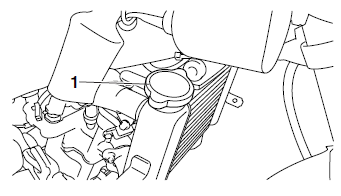
| WARNING A hot radiator is under pressure. Therefore, do not remove the radiator cap when the engine is hot. Scalding hot fluid and steam may be blown out, which could cause serious injury. When the engine has cooled, open the radiator cap as follows: Place a thick rag or a towel over the radiator cap and slowly turn the radiator cap counterclockwise toward the detent to allow any residual pressure to escape. When the hissing sound has stopped, press down on the radiator cap and turn it counterclockwise to remove. |
3. Remove:
- Coolant drain bolt "1" (along with the copper washer)
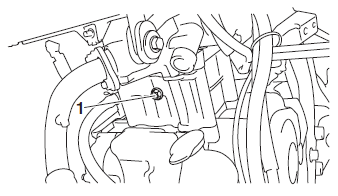
4. Drain:
- Coolant (from the engine and radiator)
5. Disconnect:
- Coolant reservoir hose "1"
6. Remove:
- Coolant reservoir cap "2"
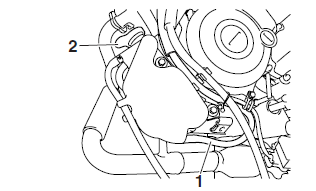
7. Drain:
- Coolant (from the coolant reservoir)
8. Connect:
- Coolant reservoir hose
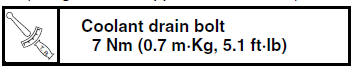
9. Install:
- Coolant drain bolt
(along with the copper washer
 )
)
10.Fill:
- Cooling system
(with the specified amount of the recommended
coolant)
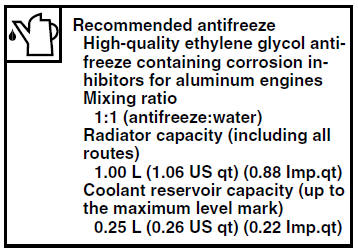
Handling notes for coolant Coolant is potentially harmful and should be handled with special care.
WARNING
|
CAUTION:
|
11.Install:
- Radiator cap
12.Fill:
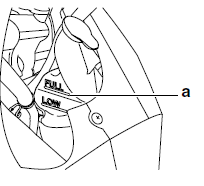
- Coolant reservoir
(with the recommended coolant to the maximum
level mark "a")
13.Install:
- Coolant reservoir cap
14.Start the engine, warm it up for several minutes, and then turn it off.
15.Check:
- Coolant level Refer to "CHECKING THE COOLANT LEVEL" on page 3-15.
NOTE:
Before checking the coolant level, wait a few minutes until the coolant has settled.
16.Install:
- Lower side cowlings Refer to "GENERAL CHASSIS" on page 4-1.
 Checking the cooling system
1. Remove:
Side covers
Upper side cowlings
Refer to "GENERAL CHASSIS" on page 4-1.
2. Check:
Radiator "1"
Radiator inlet hose "2"
Radiator outlet hose "3"
Coolant reservoir hose ...
 Chassis
...
Other materials:
Adjusting the throttle cable free play
NOTE:
Prior to adjusting the throttle cable free play, the
engine idling speed should be adjusted.
1. Check:
Throttle cable free play "a"
Out of specification →Adjust.
2. Remove:
Right side panel
Refer to "GENERAL CHASSIS" on page 4-1.
3. Adjust:
Throttle cable f ...
Disassembling the front fork legs
The following procedure applies to both of the
front fork legs.
1. Remove:
Rubber cap
Clip "1"
Front fork cap "2"
(with O-ring)
Fork spring
NOTE:
Push the front fork cap in the direction of the arrow
shown in the illustration to remove the clip.
2. Drain:
Fork oil
NOTE ...
Troubleshooting method
The engine operation is not normal and the
engine trouble warning light comes on.
1. Check:
Fault code number
a. Check the fault code number displayed on
the FI diagnostic tool.
b. Identify the faulty system with the fault code.
Refer to "Self-Diagnostic Function table".
c. Identi ...