
Yamaha YZF-R125 Service Manual: Setting the normal mode
NOTE:
The engine speed, coolant temperature, and fault code, if detected, can be displayed on the LCD of the FI diagnostic tool when the tool is connected to the vehicle and is set to the normal mode.
1. Set the main switch to "OFF" and the engine stop switch to " ".
".
2. Disconnect the self-diagnosis signal connector "1", and then connect the FI diagnostic tool "2" as shown.
3. Set the main switch to "ON" and start the engine.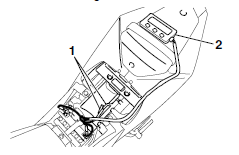
NOTE:
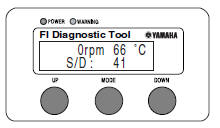
- The coolant temperature and engine speed appear on the LCD of the FI diagnostic tool.
- "POWER" LED (green) comes on.
- If a malfunction is detected in the system, the "WARNING" LED (orange) comes on.
4. Stop the engine.
NOTE:
If a malfunction is detected in the system, the fault code appears on the
LCD of the FI diagnostic tool
and the "WARNING" LED (orange) comes on.
5. Set the main switch to "OFF" to cancel the normal mode.
6. Disconnect the FI diagnostic tool and connect the self-diagnosis signal connector.
 Diagnostic mode
It is possible to monitor the sensor output data or check the activation of
actuators with the FI diagnostic
tool connected to the vehicle and set to the normal mode or the diagnostic
monitoring ...
 Setting the diagnostic mode
1. Set the main switch to "OFF" and the engine stop switch to "
".
2. Disconnect the self-diagnosis signal connector "1", and then connect the FI
diagnostic tool "2" as
shown.
3. Disconnect ...
Other materials:
Checking the rear wheel
1. Check:
Rear wheel axle
Rear wheel
Wheel bearings
Oil seals
Refer to "CHECKING THE FRONT WHEEL"
on page 4-8.
2. Check:
Tire
Rear wheel
Damage/wear → Replace.
Refer to "CHECKING THE TIRES" on page
3-23 and "CHECKING THE WHEELS" on
page 3-25.
3. Measure:
Radi ...
Checking the valves and valve guides
The following procedure applies to all of the
valves and valve guides.
1. Measure:
Valve-stem-to-valve-guide clearance
Out of specification Replace the
valve
guide.
Valve-stem-to-valve-guide clearance =
Valve guide inside diameter "a" -
Valve stem diameter "b"
2. Replace:
...
Installing the generator
1. Install:
Woodruff key
Generator rotor
Washer
Generator rotor nut
NOTE:
Clean the tapered portion of the crankshaft and
the generator rotor hub.
When installing the generator rotor, make sure
the woodruff key is properly sealed in the keyway
of the crankshaft.
2. Tighte ...