
Yamaha YZF-R125 Service Manual: Checking the valve seats
The following procedure applies to all of the valves and valve seats.
1. Eliminate:
- Carbon deposits (from the valve face and valve seat)
2. Check:
- Valve seat
Pitting/wear
 Replace the
cylinder head.
3. Measure:
- Valve seat width C "a"
Out of specification
 Replace
the cylinder head.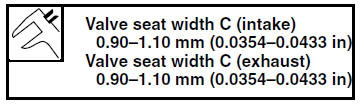
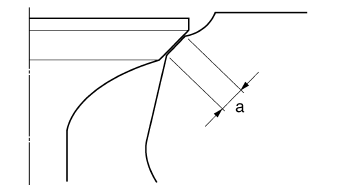
a. Apply Mechanic's blueing dye (Dykem) "b" onto the valve face.
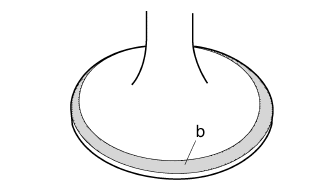
b. Install the valve into the cylinder head.
c. Press the valve through the valve guide and onto the valve seat to make a clear impression.
d. Measure the valve seat width.
NOTE:
Where the valve seat and valve face contacted one another, the blueing will have been removed.
4. Lap:
- Valve face
- Valve seat
NOTE:
After replacing the cylinder head or replacing the valve and valve guide, the valve seat and valve face should be lapped.
a. Apply a coarse lapping compound "a" to the valve face.
| CAUTION: Do not let the lapping compound enter the gap between the valve stem and the valve guide. |
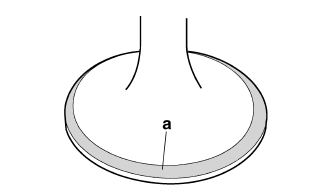
b. Apply molybdenum disulfide oil onto the valve stem.
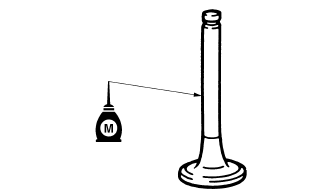
c. Install the valve into the cylinder head.
d. Turn the valve until the valve face and valve seat are evenly polished, then clean off all of the lapping compound.
NOTE:
For the best lapping results, lightly tap the valve seat while rotating the valve back and forth between your hands.
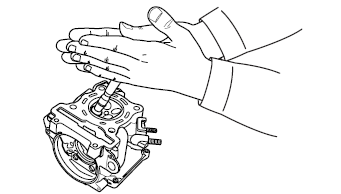
e. Apply a fine lapping compound to the valve face and repeat the above steps.
f. After every lapping procedure, be sure to clean off all of the lapping compound from the valve face and valve seat.
g. Apply Mechanic's blueing dye (Dykem) "b" onto the valve face.
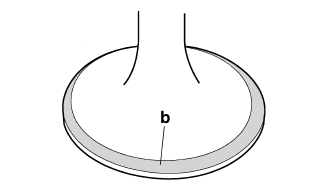
h. Install the valve into the cylinder head.
i. Press the valve through the valve guide and onto the valve seat to make a clear impression.
j. Measure the valve seat width "c" again. If the valve seat width is out of specification, reface and lap the valve seat.
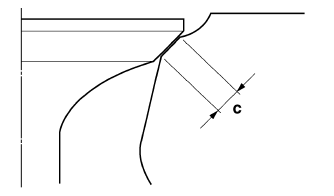
 Checking the valves and valve guides
The following procedure applies to all of the
valves and valve guides.
1. Measure:
Valve-stem-to-valve-guide clearance
Out of specification Replace the
valve
guide.
Valve-stem-to-valve ...
 Checking the valve springs
The following procedure applies to all of the
valve springs.
1. Measure:
Valve spring free length "a"
Out of specification Replace the valve
spring.
2. Measure:
Compressed valve ...
Other materials:
Checking the engine oil level
1. Stand the vehicle on a level surface.
NOTE:
Place the vehicle on a suitable stand.
Make sure the vehicle is upright.
2. Start the engine, warm it up for several minutes,
and then turn it off.
3. Check:
Engine oil level
The engine oil level should be between the
minimum level ...
Checking the front brake caliper
1. Check:
Brake caliper pistons "1"
Rust/scratches/wear Replace the
brake
caliper assembly.
Brake caliper body "2"
Cracks/damage Replace the brake
caliper
assembly.
Brake fluid delivery passages
(brake caliper body)
Obstruction Blow out with
compressed air.
...
Checking and replacing the rear wheel sprocket
1. Check:
Rear wheel sprocket
More than 1/4 tooth "a" wear
Replace the
rear wheel sprocket.
Bent teeth Replace the rear
wheel sprocket.
b. Correct
1. Drive chain roller
2. Rear wheel sprocket
2. Replace:
Rear wheel sprocket
a. Remove the self-locking nuts and the ...