
Yamaha YZF-R125 Service Manual: Replacing the front brake pads
NOTE:
When replacing the brake pads, it is not necessary to disconnect the brake hose or disassemble the brake caliper.
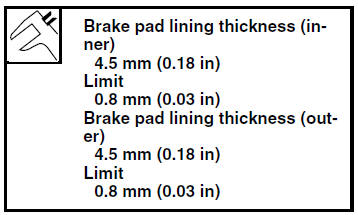
1. Measure:
- Brake pad wear limit "a"
Out of specification
 Replace
the brake pads as a set.
2. Install:
- Brake pad support

- Brake pad spring

- Brake pads

NOTE:
Always install new brake pads, a new brake pad spring and a new brake pad support as a set.
a. Connect a clear plastic hose "1" tightly to the bleed screw "2". Put the other end of the hose into an open container.
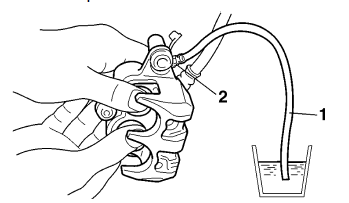
b. Loosen the bleed screw and push the brake caliper pistons into the brake caliper with your fingers.
c. Tighten the bleed screw. 
d. Install new brake pad support, a new brake pad spring and new brake pads.
NOTE:
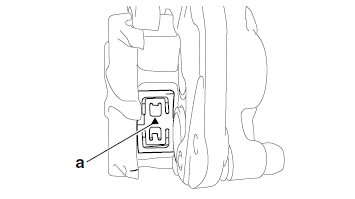
The arrow mark "a" on the brake pad spring must point in the direction of disc rotation.
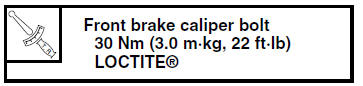
3. Install:
- Brake pad pin
- Brake pad clips
- Front brake caliper
4. Check:
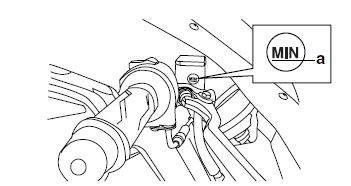
- Brake fluid level
Below the minimum level mark "a" → Add
the
recommended brake fluid to the proper level.
Refer to "CHECKING THE BRAKE FLUID LEVEL" on page 3-18.
5. Check:
- Brake lever operation
Soft or spongy feeling
 Bleed
Bleed
the brake system.Refer to "BLEEDING THE HYDRAULIC BRAKE SYSTEM" on page 3-20.
 Checking the front brake disc
1. Remove:
Front wheel
Refer to "FRONT WHEEL" on page 4-6.
2. Check:
Brake disc
Damage/galling Replace.
3. Measure:
Brake disc deflection
Out of specification Correct the
b ...
 Removing the front brake caliper
NOTE:
Before disassembling the brake caliper, drain
the brake fluid from the entire brake system.
1. Remove:
Brake hose union bolt "1"
Copper washers "2"
Brake hose "3"
NOTE:
Put the en ...
Other materials:
Checking the ignition coil
1. Check:
Primary coil resistance
Out of specification Replace.
a. Disconnect the ignition coil connectors from
the ignition coil terminals.
b. Connect the pocket tester ( × 1)
to the ignition
coil as shown.
Positive tester probe
red/white "1"
Negative tester probe
orange ...
Removing the rear brake caliper
NOTE:
Before disassembling the brake caliper, drain
the brake fluid from the entire brake system.
1. Remove:
Union bolt "1"
Copper washers "2"
Brake hose "3"
NOTE:
Put the end of the brake hose into a container
and pump out the brake fluid carefully. ...
Checking the valve seats
The following procedure applies to all of the
valves and valve seats.
1. Eliminate:
Carbon deposits
(from the valve face and valve seat)
2. Check:
Valve seat
Pitting/wear Replace the
cylinder head.
3. Measure:
Valve seat width C "a"
Out of specification Replace
the ...