
Yamaha YZF-R125 Service Manual: Checking and lubricating the cables
The following procedure applies to all of the inner and outer cables.
| WARNING Damaged outer cable may cause the cable to corrode and interfere with its movement. Replace damaged outer cable and inner cables as soon as possible. |
1. Check:
- Outer cable
Damage
 Replace.
2. Check:
- Cable operation
Rough movement
 Lubricate.
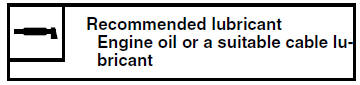
NOTE:
Hold the cable end upright and pour a few drops of lubricant into the cable sheath or use a suitable lubricating device.
Lubricating the clutch lever
Lubricate the pivoting point and metal-to-metal
moving parts of the lever.
Lubricating the brake lever
Lubricate the pivoting point and metal-to-metal
moving parts of the lever. 
Lubricating the pedals
Lubricate the pivoting point and metal-to-metal
moving parts of the pedals. 
Lubricating the sidestand
Lubricate the pivoting point and metal-to-metal
moving parts of the sidestand.
Lubricating the rear suspension
Lubricate the pivoting point and metal-to-metal
moving parts of the rear suspension.

 Checking the wheels
The following procedure applies to both of the
wheels.
1. Check:
Wheel
Damage/out-of-round → Replace.
WARNINGNever attempt to make any repairs to the
wheel.
NOTE:
After a t ...
 Electrical system
Checking and charging the battery
Refer to "ELECTRICAL COMPONENTS" on
page 8-57.
Checking the fuses
Refer to "ELECTRICAL COMPONENTS" on
page 8-57. ...
Other materials:
Checking the primary driven gear
1. Check:
Primary driven gear "1"
Damage/wear Replace the
primary drive
gear and clutch housing as a set.
Excessive noise during operation
Replace
the primary drive gear and clutch housing as
a set.
...
Be a Responsible Owner
As the vehicle's owner, you are responsible
for the safe and proper operation
of your motorcycle.
Motorcycles are single-track vehicles.
Their safe use and operation are dependent
upon the use of proper riding
techniques as well as the expertise of
the operator. Every operator should
...
Ignition circuit cut-off system
The ignition circuit cut-off system (comprising
the sidestand switch, clutch
switch and neutral switch) has the following
functions.
It prevents starting when the transmission
is in gear and the sidestand
is up, but the clutch lever is
not pulled.
It prevents starting when the t ...