
Yamaha YZF-R125 Owners Manual: Tires
To maximize the performance, durability, and safe operation of your motorcycle, note the following points regarding the specified tires.
Tire air pressure
The tire air pressure should be checked and, if necessary, adjusted before each ride.
 WARNING
Operation of this vehicle with improper
tire pressure may cause severe
injury or death from loss of
control.
- The tire air pressure must be checked and adjusted on cold tires (i.e., when the temperature of the tires equals the ambient temperature).
- The tire air pressure must be adjusted in accordance with the riding speed and with the total weight of rider, passenger, cargo, and accessories approved for this model.
| Tire air pressure (measured on cold tires): 0-90 kg (0-198 lb): Front: 175 kPa (1.75 kgf/cm², 25 psi) Rear: 200 kPa (2.00 kgf/cm², 29 psi) 90-185 kg (198-408 lb): Front: 175 kPa (1.75 kgf/cm², 25 psi) Rear: 225 kPa (2.25 kgf/cm², 33 psi) Maximum load*: 185 kg (408 lb) * Total weight of rider, passenger, cargo and accessories |
WARNING
Never overload your vehicle. Operation
of an overloaded vehicle could
cause an accident.
Tire inspection
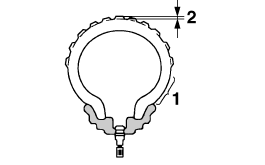
- Tire sidewall
- Tire tread depth
The tires must be checked before each ride. If the center tread depth reaches the specified limit, if the tire has a nail or glass fragments in it, or if the sidewall is cracked, have a Yamaha dealer replace the tire immediately.
| Minimum tire tread depth (front and rear): 1.6 mm (0.06 in) |
TIP
The tire tread depth limits may differ
from country to country. Always comply
with the local regulations.
WARNING
- Have a Yamaha dealer replace excessively worn tires. Besides being illegal, operating the vehicle with excessively worn tires decreases riding stability and can lead to loss of control.
- The replacement of all wheel and brake related parts, including the tires, should be left to a Yamaha dealer, who has the necessary professional knowledge and experience.
Tire information
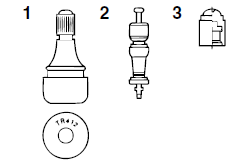
- Tire air valve
- Tire air valve core
- Tire air valve cap with seal
This motorcycle is equipped with cast wheels and tubeless tires with valves.
WARNING
- The front and rear tires should be of the same make and design, otherwise the handling characteristics of the motorcycle may be different, which could lead to an accident.
- Always make sure that the valve caps are securely installed to prevent air pressure leakage.
- Use only the tire valves and valve cores listed below to avoid tire deflation during a ride.
After extensive tests, only the tires listed below have been approved for this model by Yamaha Motor Co., Ltd.
| Front tire: Size: 100/80-17 M/C 52H Manufacturer/model: PIRELLI/SPORT DEMON MICHELIN/PILOT SPORTY Tire air valve: TR412 Valve core: V3002 (original) Rear tire: Size: 130/70-17 M/C 62H Manufacturer/model: PIRELLI/SPORT DEMON MICHELIN/PILOT SPORTY Tire air valve: TR412 Valve core: V3002 (original) |
WARNING
This motorcycle is fitted with superhigh-
speed tires. Note the following
points in order to make the most efficient
use of these tires.
- Use only the specified replacement tires. Other tires may run the danger of bursting at super high speeds.
- Brand-new tires can have a relatively poor grip on certain road surfaces until they have been "broken in". Therefore, it is advisable before doing any highspeed riding to ride conservatively for approximately 100 km (60 mi) after installing a new tire.
- The tires must be warmed up before a high-speed run.
- Always adjust the tire air pressure according to the operating conditions.
 Valve clearance
The valve clearance changes with use,
resulting in improper air-fuel mixture
and/or engine noise. To prevent this
from occurring, the valve clearance
must be adjusted by a Yamaha dealer
at t ...
 Cast wheels
To maximize the performance, durability,
and safe operation of your vehicle,
note the following points regarding the
specified wheels.
The wheel rims should be checked
for cracks, bends o ...
Other materials:
General maintenance and lubrication chart
TIP
The air filter needs more frequent service if you are riding in
unusually wet or dusty areas.
Hydraulic brake service
Regularly check and, if necessary, correct the brake fluid level.
Every two years change the brake fluid.
Replace the brake hoses every four ye ...
Chassis tightening torques
NOTE:
First, tighten the lower ring nut to approximately 48 Nm (4.8 m.kg,
35 ft.lb) with a torque wrench, then
loosen the lower ring nut completely.
Retighten the lower ring nut to 13 Nm (1.3 m.kg, 9.4 ft.lb) with a
torque wrench.
...
Checking the shift drum assembly
1. Check:
Shift drum groove
Damage/scratches/wear Replace
the shift
drum assembly.
Shift drum segment "1"
Damage/wear Replace the
shift drum assembly.
Shift drum bearing "2"
Damage/pitting Replace the
shift drum assembly.
...